
Teaching arrangement by NotePlayMusic
Practice tips
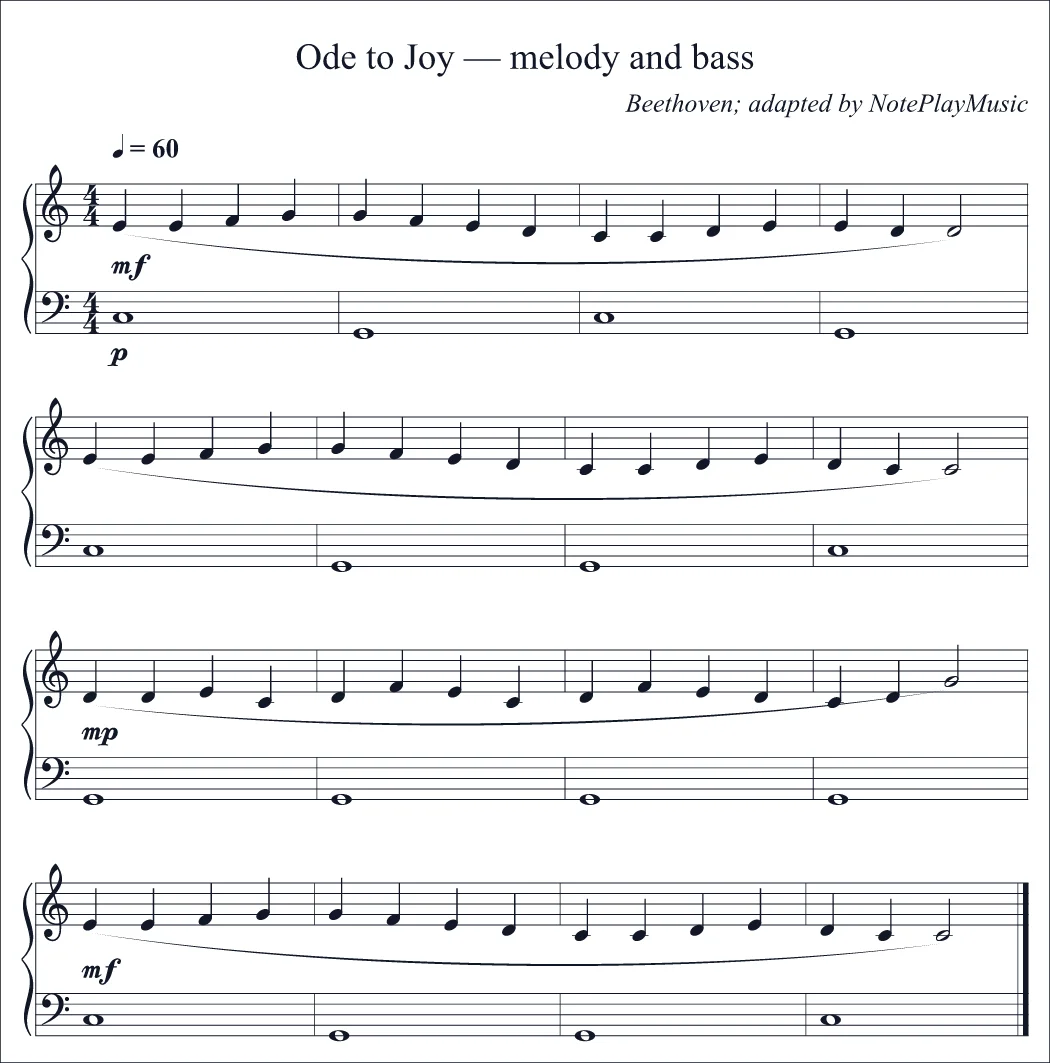
- Learn the right-hand melody on its own first. It stays on C4 to G4, with your thumb on middle C.
- For the bass, place your left little finger on G2 and your thumb on C3. Hold each written bass note for all four beats.
- In the middle bridge section (bars 9–12), the left hand anchors on a low G2 pedal while the melody steps above it.
- The curved slurs group four-bar melody phrases. Connect different notes smoothly and gently rearticulate repeated notes; a slur is not a tie.
- Begin the melody at mf (moderately loud), soften to mp (moderately soft) in bars 9–12, then return to mf in bar 13. Keep the bass at p (soft) so it supports rather than covers the melody. These markings are NotePlayMusic editorial suggestions.
Arrangement details
Bring both hands together: play the complete 16-bar melody with your right hand while the left hand holds one bass note per bar.
NotePlayMusic 16-bar adaptation of the complete main theme: transposed from G major to C major, kept within C4–G4, and paired with a C/G whole-note bass exercise for two-hand coordination. Four-bar melody slurs, mf/mp melody dynamics and a p bass dynamic are NotePlayMusic editorial performance suggestions, not original composer markings.
Next steps: The five-note right-hand melody is combined with a left-hand bass note held for four beats. Read treble and bass clefs together and coordinate changes at each bar line.
Our reading levels describe the arrangement; they are not official exam grades.
- Read a piano grand staff
- Hold a bass note while the melody moves
- Coordinate both hands across a 16-bar piece
Source edition typeset by Peter Chubb; melody by Ludwig van Beethoven. The source edition is marked Public Domain by its typesetter.