
Teaching arrangement by NotePlayMusic
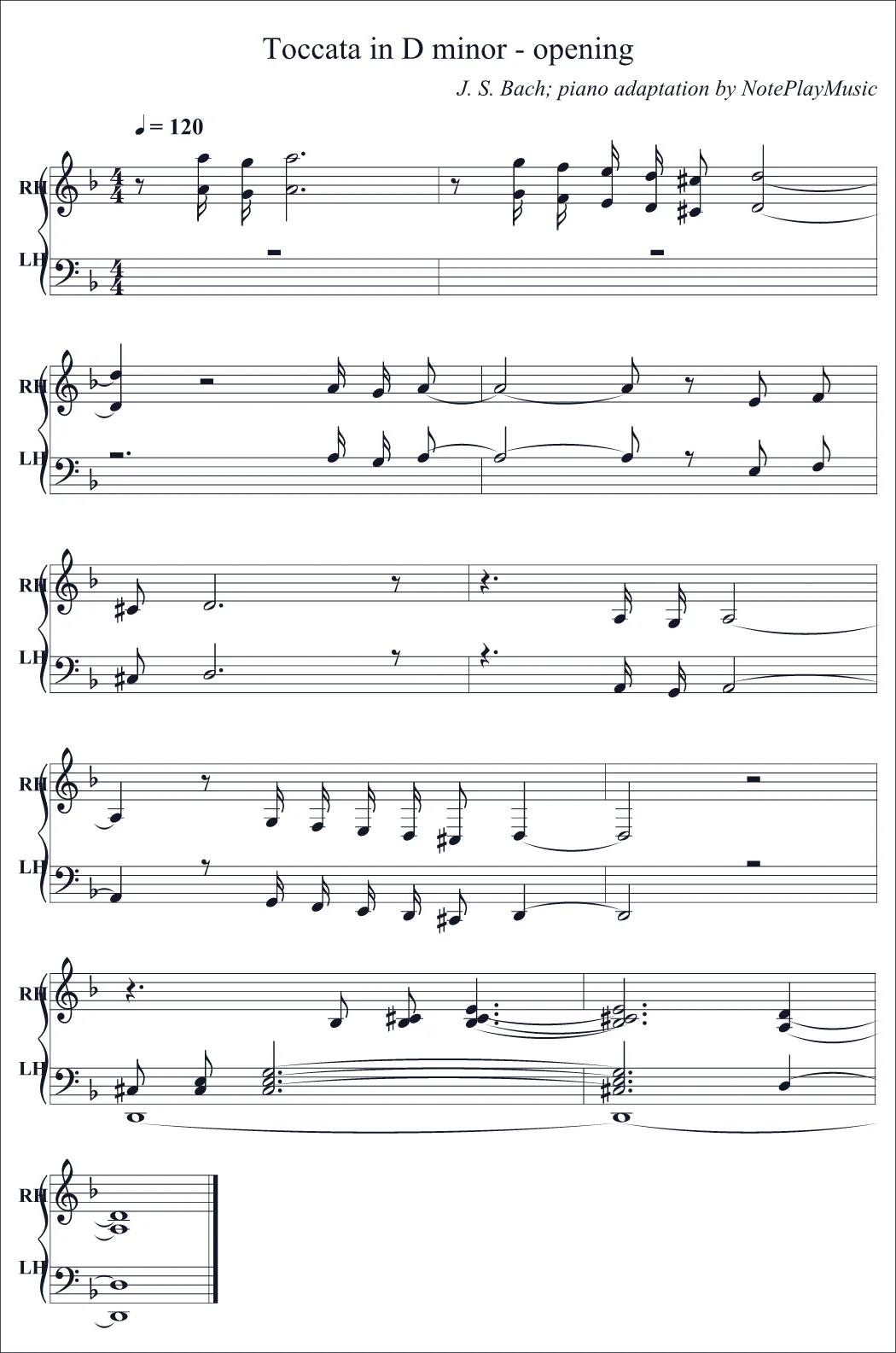
Practice tips
- Start at half speed and learn each descending call separately before joining both hands.
- The final low D continues underneath the moving left-hand chords. Keep it held where comfortable; pedal may help, but avoid blurring the other notes.
- The written holds and rests already encode the video timing. Do not add extra fermatas when comparing the score with the video.
Arrangement details
Read, hear and practise the exact two-hand piano adaptation used in our falling-note video.
Generated from the same right-hand and two left-hand voice specifications as the video, including its initial rest, chord attacks, sustained low D and final open fifth. Editorial 4/4 bars and explicit held-note values encode the 120 bpm performance, including interpreted fermatas. The organ pedal is reduced for piano and the final lower-voice turn is omitted. This is the shortened piano adaptation, not the complete original organ score.
Developing: Octaves, sixteenth-note runs, ledger lines, changing hand positions and a held low D under moving chords make this more demanding than the starter melodies.
Our reading levels describe the arrangement; they are not official exam grades.
- Read treble and bass clefs together
- Coordinate octave calls and short runs
- Hold a low bass note while other chord tones change
Watch this adaptation
Traditionally attributed to J. S. Bach; Bach-Gesellschaft Ausgabe, 1867, typeset by Mutopia. Piano adaptation by NotePlayMusic. The composition and source typesetting are public domain.
Source notation · Source score & rights notice
Complete original organ score (PDF) — source edition, not the shortened piano adaptation above.