
Dies Irae
chant and tolling fifths
16-bar chant with deep bass · piano both hands · D minor (Dorian) · 4/4Traditional 13th-century chant (quoted by Berlioz & Liszt)
Teaching arrangement by NotePlayMusic
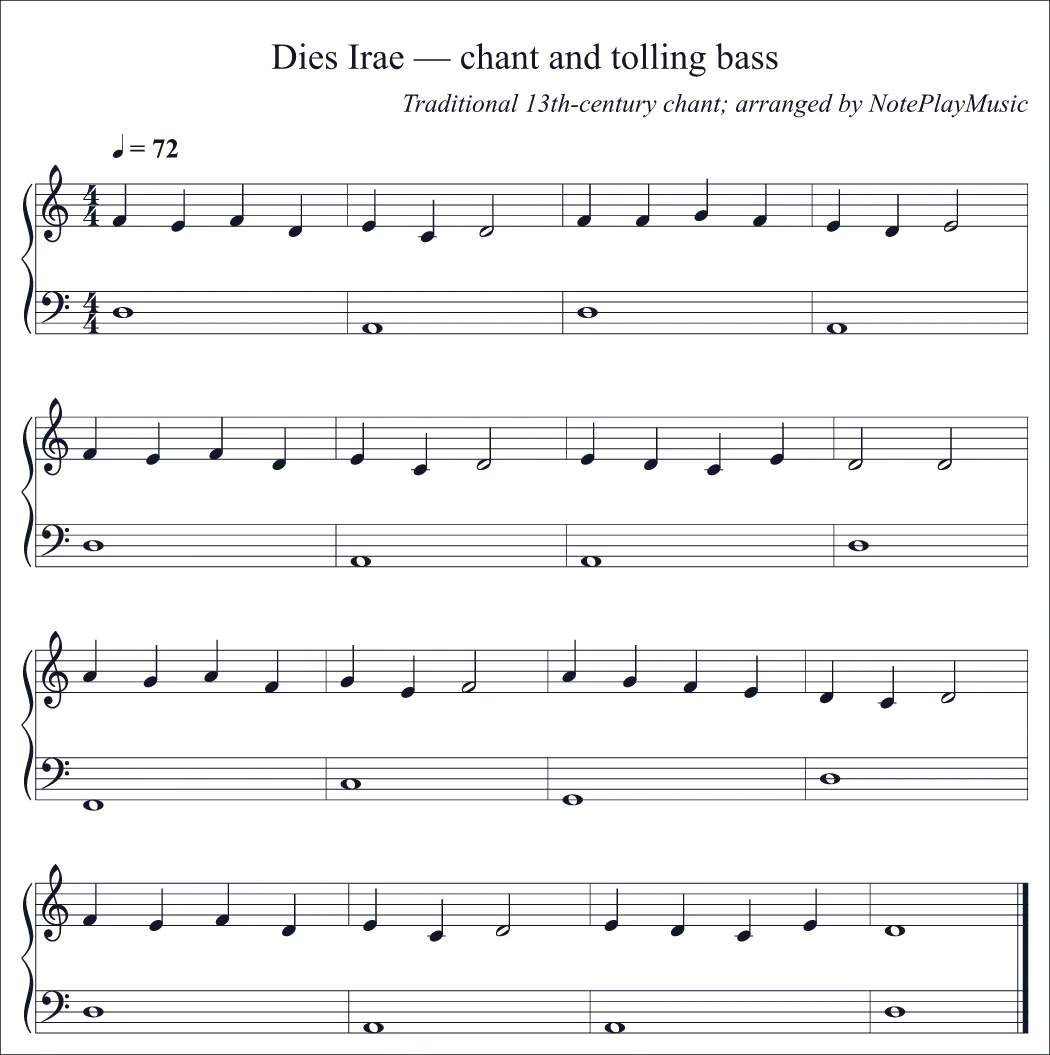
Practice tips
- Hold each left-hand semibreve for all four beats so it rings like a cathedral bell underneath the right hand.
- In bars 9–12, shift your right hand up one step so your 5th finger reaches A4.
- Listen to how the C natural against the D bass gives the ancient Dorian sound.
Arrangement details
Combine the haunting 16-bar Dies Irae melody with deep, bell-like bass notes in the left hand.
Pairs the 16-bar 4/4 white-key Dies Irae melody with sustained D, F, C, G and A bass notes.
Next steps: Pairs the right-hand chant melody with sustained low D, A, F and G bass notes.
Our reading levels describe the arrangement; they are not official exam grades.
- Coordinate a modal melody with deep bass notes
- Read D, F, G and A in the bass clef
- Create a dark, bell-like atmosphere with two hands
Traditional 13th-century liturgical melody; rhythmic piano arrangement by NotePlayMusic. Public domain medieval melody. Teaching arrangement newly authored by NotePlayMusic.